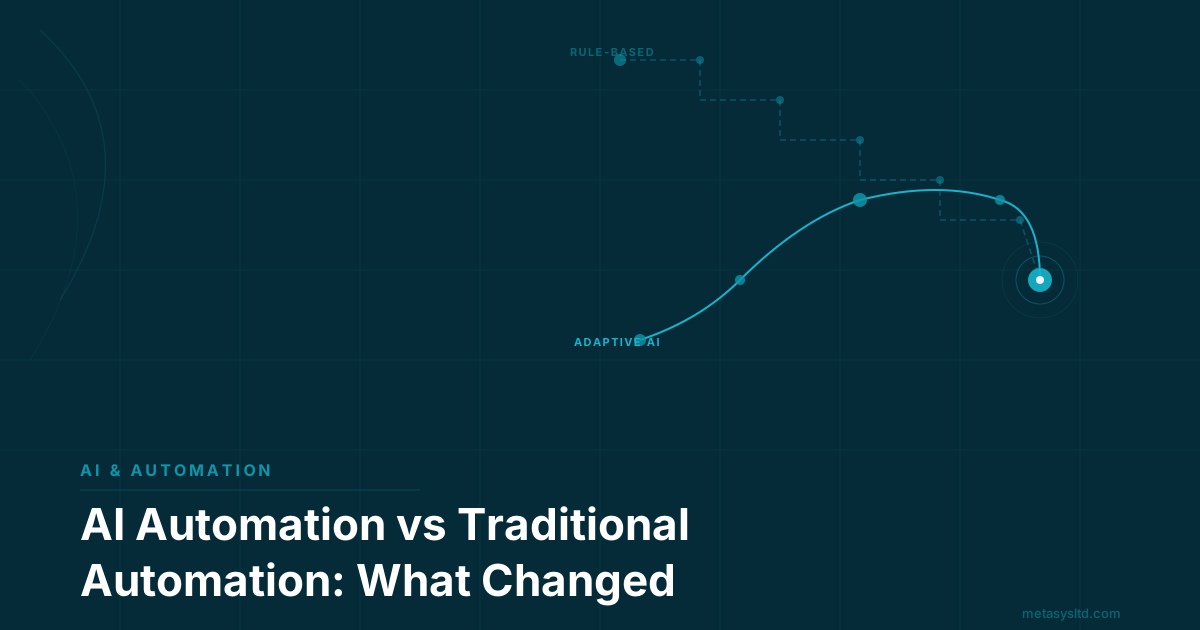
Traditional automation, at its core, encodes rules. You define exactly what should happen under every circumstance the system is expected to encounter, and the automation follows those rules without deviation.
This works well when processes are stable, inputs are predictable, and exceptions are rare. For high-volume, well-defined back-office operations, such as invoice processing, data migration between known systems, and report generation, rule-based tools have delivered real value for years.
Where traditional automation breaks down
The problem emerges at the edge cases. No set of rules covers everything. When an invoice arrives in an unusual format, an RPA bot either misclassifies it, routes it to an exception queue, or fails outright. In environments where a meaningful percentage of inputs are non-standard, exception queues grow large enough to consume the efficiency gains automation was supposed to create.
Three structural weaknesses define where traditional automation plateaus:
- Fragility under change. If the underlying system changes its interface, a field moves, a dropdown adds an option, or a web element gets a new ID, the bot breaks. Maintenance overhead in large RPA deployments can be significant.
- Inability to handle unstructured data. Traditional automation assumes inputs are structured and consistently formatted. Documents, emails, and free-text fields are outside its scope without a separate extraction layer.
- No judgment. When a rule does not apply, the automation cannot reason about what to do instead. It requires an explicit instruction for every situation it might encounter.
What AI adds
AI automation adds the ability to interpret, reason, and adapt. A system using natural language processing can read a document in any format and extract relevant data. A system using a language model can evaluate an ambiguous situation and decide on an appropriate action.
This does not mean AI automation is always better. It introduces different tradeoffs: more complex to validate, harder to audit in certain cases, and requiring different kinds of test coverage. But for processes where traditional automation plateaus because of exception rates or data variability, AI changes what is achievable.
The capabilities that matter most in practice:
- Document understanding: reading invoices, contracts, and claims in any format
- Intent classification: routing requests based on meaning, not keywords
- Structured extraction from unstructured text
- Decision support at ambiguous process steps
A decision framework
Use traditional automation when:
- The process is stable and expressible as rules
- Inputs are consistently structured
- Exception rates are low, under five percent
- Complete auditability of every decision is required
Use AI automation when:
- Inputs vary significantly in format or content
- The process requires interpretation of natural language
- Exception rates are high enough that rule maintenance is costly
- The business outcome requires adapting to context
Use both together when the high-volume, predictable subset of a process runs through rules-based automation and the variable or unstructured subset routes through an AI layer. Both feed into a unified orchestration and monitoring layer. This combined approach is often the most practical path for businesses with existing automation investments.
The practical implication
The mistake companies make is treating AI automation as a wholesale replacement for traditional automation. The better framing is that each tool has a job. Traditional automation handles the deterministic, high-volume baseline. AI automation handles the interpretive, variable layer on top.
The integration between them, and the monitoring that tells you when something is not working, is where most of the implementation work lives. Getting this architecture right from the start avoids the pattern we see most often: an AI automation project that adds capability in one area while creating a maintenance burden in another because the integration was designed hastily.
For a detailed look at how we implement AI workflow automation across enterprise environments, see our AI Intelligent Automation capability page. For organizations managing this change alongside existing operational commitments, our Business Modernization service covers the sequencing approach.
For teams building beyond workflow automation and requiring systems that can plan, act, and adapt autonomously across multi-step tasks, our Agentic AI Systems capability covers the architecture and deployment patterns in detail.