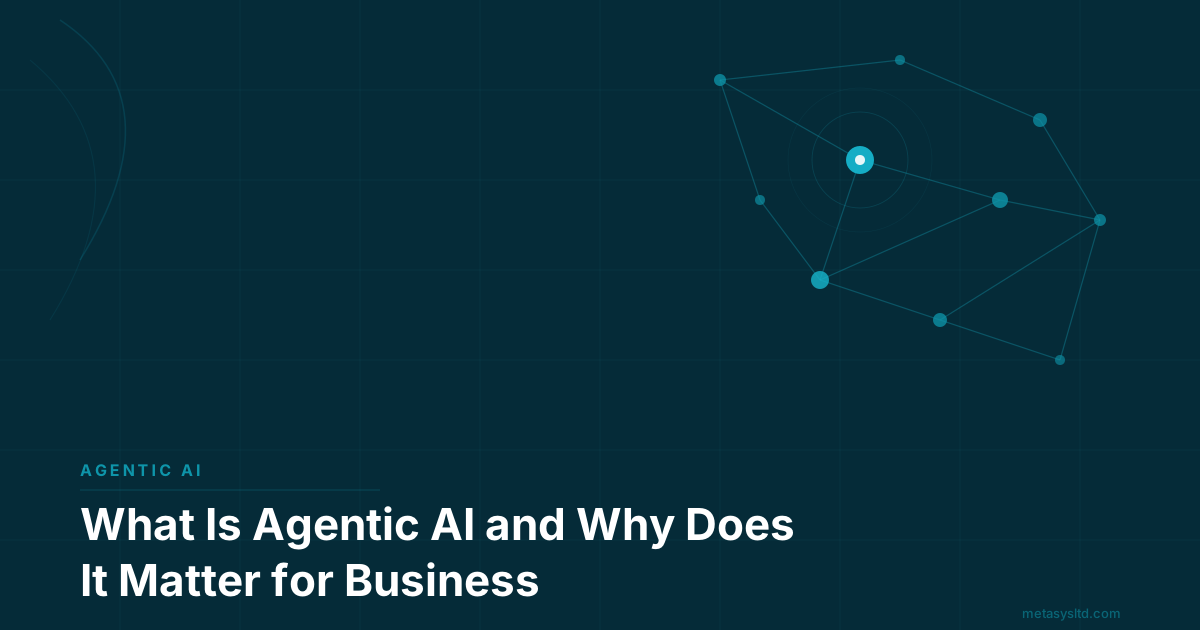
Agentic AI refers to autonomous AI systems that do not just respond to questions. They execute multi-step tasks to accomplish goals. Where a chatbot waits to be asked something, an agent decides what to do next based on the current state of a task, executes that action, observes what happened, and plans the next step.
The distinction matters because it changes what is possible. Enterprise AI agents that can plan, use tools, and adapt to intermediate results can handle work that previously required human judgment at every step.
How agents plan and execute
An agent operates in a loop. It receives a goal, breaks it into steps, executes actions against available tools (calling APIs, querying databases, running code, sending messages), observes the result of each action, and adjusts its plan. This cycle continues until the goal is reached, the agent hits a defined stopping condition, or it hands off to a human.
The tools available to an agent define its capabilities. A well-designed agent uses only the tools it needs, with clear boundaries on what it can and cannot do autonomously. Over-permissioning an agent, giving it write access to systems that only need to be read, is one of the most common architecture mistakes in early deployments.
Real business examples
In procurement, an agent can monitor supplier contracts, flag upcoming renewals, request quotes from multiple vendors, compare them against internal pricing benchmarks, and draft a recommendation for a procurement manager to review. No human input is needed at each step. The procurement manager reviews the recommendation, not each individual action.
In customer operations, an agent can read an incoming support ticket, look up the customer's account history, check relevant documentation, and either resolve the issue directly or route it with a full context summary to the right team. Resolution time drops. Escalation quality improves.
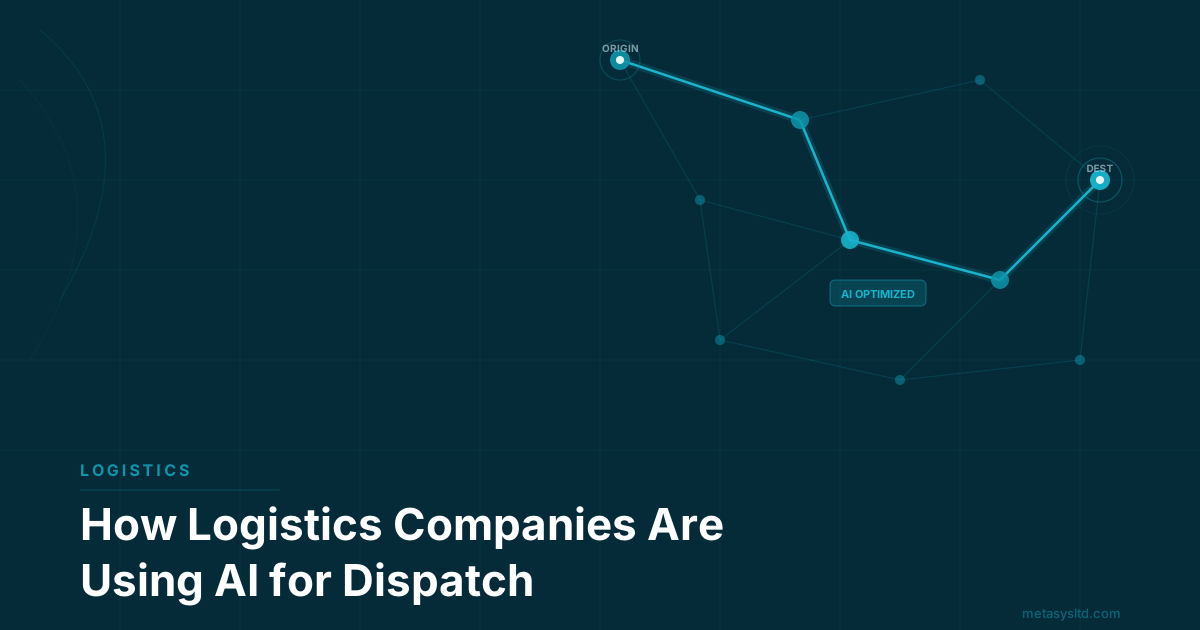
In logistics, agents handle load planning, carrier selection, and exception management. When a shipment is delayed, an agent identifies affected orders, contacts carriers for updates, notifies customers, and suggests rerouting options. The dispatcher makes the final call on rerouting; the agent removes the 40 minutes of investigation that used to precede that call. More on this in our logistics industry overview.
Humans in the loop
Agentic AI does not mean unsupervised AI. The most reliable systems include clearly defined checkpoints where human review is required before the agent proceeds. These are called human-in-the-loop gates.
A well-designed human-in-the-loop system means the agent handles research, data gathering, and option generation, while a human makes the final call on anything with significant consequences. This keeps decision quality high while removing the operational burden of low-value tasks from human queues.
The challenge is calibrating the gates correctly. Too many gates, and the agent provides marginal value over a simple workflow tool. Too few, and you introduce risk. This calibration is where most agentic AI implementations get the architecture wrong the first time.
How to assess readiness
Processes that work well for agentic AI share a few characteristics:
- Well-defined enough to give the agent a clear goal
- Data-rich enough that the agent can observe state accurately
- Recoverable if the agent makes an error
- High enough in volume that AI automation creates meaningful value
Processes that do not fit: those requiring judgment that humans themselves cannot articulate, decisions with very high irreversibility, or cases where the data the agent needs is fragmented across systems with no reliable integration path.
Our Agentic AI Systems practice covers the architecture and implementation approach in detail, from evaluation frameworks to production monitoring patterns.
Where to start
The most practical entry point is a narrow, well-scoped agent: one process, clear inputs and outputs, measurable success criteria. This gives the team experience with the architecture, builds organizational trust in agent-driven work, and produces a result that is genuinely useful.
From there, scope can expand. Trying to build a broad agentic system before understanding the operational requirements of a narrow one almost always leads to rework. The technology is ready. The more common bottleneck is process definition, data access, and change management, which are the same factors that determine whether any technology deployment succeeds.