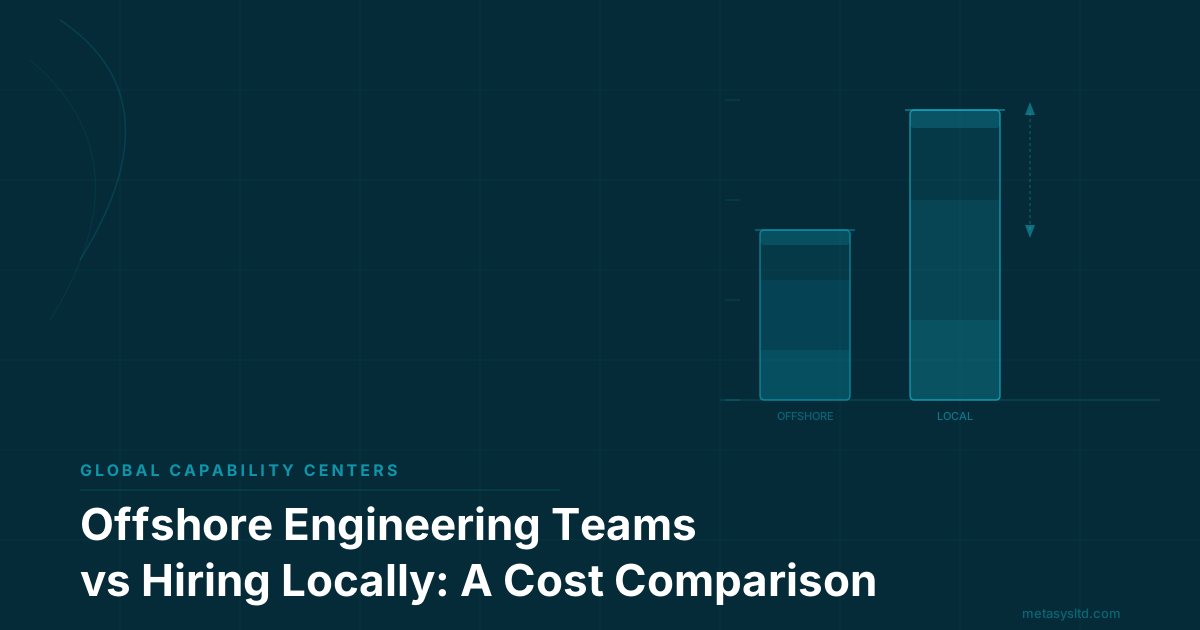
The comparison that fills most spreadsheets when this decision is being made is salary: a software engineer in San Francisco vs a software engineer in Lahore. The ratio is striking, often 5:1 or 6:1, and it is also misleading in isolation. Salary comparisons tell you one number from a multi-component cost equation and tell you nothing about the productivity, coordination, or total value delivery on either side. The organizations that make this decision well are the ones that work through the full equation rather than anchoring on the single most visible number.
This is not an argument for or against offshore engineering. It is an attempt to give you the actual numbers and the actual qualifications so you can make a decision based on your specific situation rather than on vendor marketing or fear-based intuition.
True Total Cost of a US Software Engineer in 2026
Base salary for a mid-to-senior US software engineer in a tech company in 2026 runs $130,000-$200,000 per year depending on location, specialization, and level. This is the number that dominates salary comparison slides and is also the least complete number you can use.
Benefits add 20-30% on top of base salary in a competitive US tech employer. This includes health insurance (employer contribution typically $8,000-$18,000 per year for individual plus family), 401(k) match (typically 3-6% of salary), equity (valued differently at different companies but real cost), paid time off (typically 15-25 days, worth 6-10% of salary in productivity cost), and additional perks (meals, wellness, learning budgets). A realistic benefits load is 25% on top of base.
Employer payroll taxes add 7.65% for FICA (Social Security and Medicare up to wage base) plus state unemployment insurance (0.5-3.5% depending on state). For a $160,000 base salary, FICA alone is $12,240.
Recruitment cost for a software engineer hire in the US is $15,000-$30,000 when using a recruiter (20-25% of first-year salary), or $5,000-$10,000 for direct sourcing costs including interviewer time. At an 18-24% annual attrition rate in US tech, the average tenure is 4-5 years, meaning you pay the recruitment cost roughly every 4-5 years per seat.
Fully loaded cost for a mid-senior US software engineer: $160,000 base + $40,000 benefits + $15,000 employer taxes + $5,000 annualized recruitment = $220,000 per year, or approximately $18,000 per month.
Total Cost of an Offshore Engineer via Managed GCC in Pakistan
A mid-level software engineer in Lahore earns $1,400-$2,400 per month gross in 2026. A senior engineer earns $2,400-$4,000 per month. Benefits and compliance (EOBI, health insurance, annual bonus) add 20-30%. A managed GCC partner fee adds 15-25% on top of the employment cost. At the mid-senior level, fully loaded cost via a managed partner runs $3,000-$5,500 per month depending on role seniority and partner fee structure.
For global capability centers, the 40-70% savings claim against US market rates is real at the mid-senior level when the comparison is done correctly (all-in cost vs all-in cost). The claim is misleading when the comparison is US salary vs offshore salary without including the offshore compliance, benefits, coordination, and partner fee components.
The Productivity Adjustment
Offshore teams do not always deliver equivalent output per hour to their US counterparts. The gap is real in some contexts and non-existent in others. The variables that determine whether there is a productivity gap are: how well the offshore team understands the domain (directly related to knowledge transfer quality), how much synchronous communication the work requires (more sync requirement means time zone gaps create more friction), and how well the offshore team is managed and integrated into your processes.
A well-managed offshore team with good domain knowledge, working on tasks that are appropriate for async execution, delivers output comparable to an equivalent US team. A poorly managed offshore team with insufficient context, working on tasks that require constant clarification, delivers significantly less. The productivity differential is mostly a management variable, not an inherent property of the offshore model.
Apply a conservative 15-20% productivity adjustment in the business case for the first year while teams ramp up. After the first year, if the team is well-selected and managed, this adjustment typically reduces to 5-10% for coordination overhead.
Time Zone: The Practical Reality
US Eastern to Pakistan is 9-10 hours. US Pacific to Pakistan is 12-13 hours. The synchronous overlap in a standard business day is 1-3 hours, depending on how much schedule flexibility exists on the Pakistan side. Pakistani engineers working 10am-7pm Pakistan time overlap with US East Coast 9am-12pm and with US West Coast until midnight Pakistan time.
For work that is genuinely async (development tasks with well-defined acceptance criteria, code reviews, documentation, testing), the time zone gap is not a practical problem. Work submitted end of Pakistan day is reviewed and responded to at the start of US day. Work submitted end of US day is picked up at the start of Pakistan day. The 24-hour cycle can actually increase throughput compared to a purely US team.
For work that requires frequent synchronous collaboration (product design sessions, architecture discussions, debugging sessions on live incidents), the time zone gap is a genuine operational constraint. Schedule these sessions in the overlap window and be deliberate about which roles and responsibilities require synchronous interaction vs which can operate asynchronously.
Management Overhead
Running an offshore team is not free in terms of management attention. You need someone responsible for the offshore relationship: coordinating work allocation, managing communication norms, resolving blockers, conducting performance reviews, and handling attrition. In a 20-person GCC, this is roughly 20-30% of a senior engineering manager's time plus a local country manager or team lead on the Pakistan side (budgeted in the GCC cost model).
A realistic estimate of effective capacity adjustment for coordination overhead is 15-20% of the offshore team's headline capacity in steady state. A 20-person team delivers the effective output of 16-17 people when you account for coordination, communication, and context overhead. This is not a failure of the model; it is the cost of distribution that applies to any distributed team, domestic or international.
Output Quality
Output quality from an offshore team depends almost entirely on hiring quality and management quality. The Pakistan engineering market in 2026 has a meaningful number of engineers who have worked for US and European companies, built production systems at scale, and are technically equivalent to their US counterparts. It also has a significant number of engineers whose skills are overstated relative to their experience. Distinguishing between these two groups requires a rigorous technical assessment process, which is the most important investment you make in the offshore hiring process.
The how to set up a GCC in 90 days post covers the screening process in detail, including what a rigorous technical assessment looks like for different engineering roles.
The Break-Even Math for a Team of 10
Ten US mid-senior engineers at $220,000 fully loaded per year each costs $2.2 million per year, or $183,000 per month. Ten Pakistan engineers via a managed GCC at $4,000 per month fully loaded each costs $480,000 per year, or $40,000 per month. The gross saving is $143,000 per month or $1.72 million per year. After productivity adjustment (15%), effective saving is $121,000 per month. After coordination overhead (20% of a US manager's time at $200K = $40K per year = $3,300 per month), effective saving is $117,700 per month, or approximately $1.41 million per year.
The setup cost for a managed GCC of 10 people, including recruitment, partner setup fees, and knowledge transfer capacity cost, is $80,000-$150,000. At $117,700 monthly saving, the payback period is under two months. This is why the GCC model produces compelling economics for teams of meaningful size: the fixed costs are small relative to the monthly saving.
When Local Hiring Is Still Better
Classified or sensitive work that cannot leave a jurisdiction: regulatory, government, defense, or certain financial sector requirements may prohibit offshore access to specific systems or data. Check your compliance requirements before assuming offshore is an option.
Real-time collaboration requirements where the work is inherently synchronous: product design roles that require constant iteration in live sessions, incident response roles that require immediate availability, executive-adjacent roles that require in-person participation.
Highly specialized roles with thin global supply: if you need five staff-level ML infrastructure engineers, the global supply of those engineers at any price point is limited, and the Pakistan market is unlikely to have five of them available simultaneously. For roles where the talent supply is genuinely global, offshore sourcing makes sense. For roles where the supply is thin everywhere, local hiring or remote-global sourcing is more realistic.
The Hybrid Model
The model that the most mature distributed engineering organizations use is not either/or. Senior architects, principal engineers, and engineering leaders are typically local or near-local, providing strategic direction, architecture decisions, and the context that requires deep organizational knowledge. The execution team, the engineers building features and systems against well-defined specs, is offshore. The division of labor is by judgment intensity rather than by seniority alone. For those looking to build a team in this model, careers at MetaSys reflects how MetaSys itself operates as a distributed engineering organization.