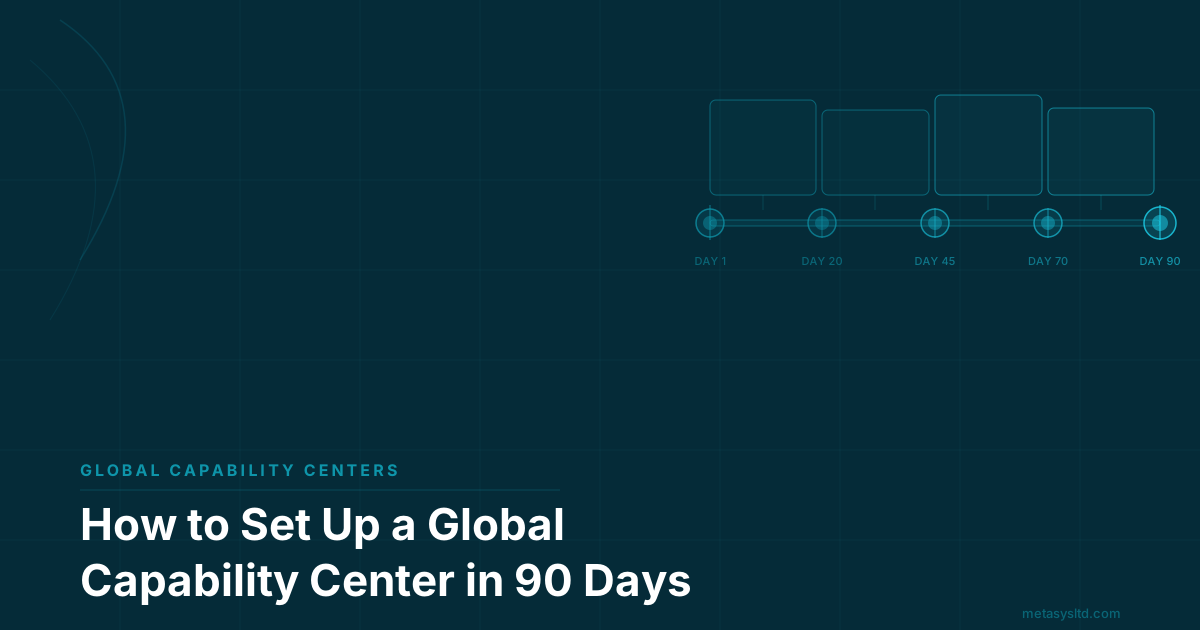
Ninety days is a realistic timeline for launching a functioning Global Capability Center if you use a managed partner model. It is not a realistic timeline for establishing a fully owned foreign subsidiary from scratch, which involves legal entity formation, bank account opening, payroll infrastructure setup, and regulatory registration that in most South Asian and Eastern European jurisdictions takes 60-120 days on their own before you hire anyone.
The managed model, where a local partner provides the legal entity, payroll infrastructure, office space, and HR operations while you direct the team's work, compresses the timeline dramatically. The tradeoff is less direct control and a service fee on top of employment costs. For most companies deploying their first global capability center, the managed model is the right first step because it gets people working faster while you build the knowledge to eventually own the entity if scale justifies it.
Days 1 to 15: Decision and Design
The work in the first two weeks is not operational. It is definitional. Before any vendor is selected, any office is viewed, or any job description is written, you need answers to six questions that will govern every subsequent decision.
First, what function does this GCC serve? Engineering, data, customer operations, finance operations, QA, or a combination? The function determines the talent profile, the tooling requirements, the communication cadence, and the management structure. Mixing functions in a GCC phase one adds complexity that is worth deferring.
Second, what is the target team size at launch and at 12 months? The economics of a GCC shift significantly at different sizes. A 10-person launch and a 30-person launch require different infrastructure investments and different management structures.
Third, what governance model will you use? Who in your organization owns the GCC relationship? How will work be allocated? What are the quality and performance standards? How will issues be escalated? These governance questions need answers in writing before the GCC launches, not after the first problem arises.
Fourth, which location? For engineering and AI/data roles, Pakistan (Lahore, Karachi, Islamabad) and India (Bangalore, Pune, Hyderabad) are the primary options in South Asia. Eastern Europe is appropriate if EU time zone proximity is essential or if the role requires a specific language capability. Each market has different salary levels, talent supply characteristics, and operational complexity.
Fifth, managed partner or fully owned entity? The decision criteria: if this is your first offshore team, if time to launch is important, and if the team is fewer than 30-40 people, managed partner is almost always the right answer. If you already have significant offshore experience and are planning 50+ headcount, a fully owned entity makes sense but requires a longer timeline.
Sixth, what is the integration model? Will the GCC team be embedded in your existing product or engineering teams (fully integrated model) or organized as a distinct delivery function with its own backlog (delivery team model)? Fully integrated teams produce higher knowledge integration but require more active management from your senior people. Delivery teams are easier to manage at arm's length but tend to produce lower-quality knowledge transfer.
Days 16 to 30: Legal and Operational Setup
For the managed partner model, days 16-30 involve partner selection, contract negotiation, and operational setup within the partner's existing structure. The partner agreement should specify: the employment terms for your team members, the IP ownership structure (all work product belongs to you), the termination and transition provisions (what happens to the team if you end the engagement), the data security and access control requirements, and the SLAs for recruitment, HR operations, and office management.
Specific to Pakistan: the major cities for tech talent are Lahore, Karachi, and Islamabad. Lahore has the deepest engineering talent pool relative to cost. Karachi is larger but more expensive and has a wider cost range. Islamabad is smaller but has a significant population of engineers who prefer it for quality of life reasons. Office space in well-connected tech district locations runs $25-$50 per desk per month in serviced office environments.
Payroll and benefits setup, even within a managed model, requires decisions: what health insurance coverage to provide, what leave policy to apply, what annual bonus structure to use. Pakistan tech market norms include 18-20 days annual leave, a one-month annual bonus (equivalent to Eid bonus), and health insurance for the employee and immediate family. Deviating significantly from these norms in either direction (less generous makes hiring harder, more generous is unnecessary) is not recommended.
Days 31 to 50: Hiring
The hiring phase is where the 90-day timeline lives or dies. Recruiting for a 10-20 person team in 20 days is aggressive but achievable if job descriptions are ready, the sourcing channels are active, and decision-making is fast. Delays at any of these points push the timeline out.
For Pakistan engineering roles, the primary sourcing channels in 2026 are LinkedIn (effective for senior roles), local tech communities and Slack groups (effective for mid-level), and direct referral networks (effective for high-trust senior hires). Agency recruitment is an option but agencies add cost and their databases skew toward candidates who are actively circulating on the market, which sometimes excludes the strongest candidates who are comfortably employed.
The screening process for engineering roles should include: a technical assessment (take-home or timed, depending on role seniority), a technical interview with someone from your existing engineering team, and a culture and communication interview. Do not skip the technical assessment. Self-reported skills in the Pakistan engineering market, as in any market, vary widely in accuracy.
Offer and onboarding in Pakistan: notice periods for mid-to-senior roles are typically 30-60 days (sometimes up to 90 for senior roles). Build this into your timeline. Candidates who accept an offer and then disappear due to a counter-offer are less common than in the US market but not unknown. A signed contract with a start date is more reliable than a verbal acceptance.
Days 51 to 70: Infrastructure and Tooling
The development environment setup for the GCC team needs to match your existing team's environment closely enough that work products are compatible. Version control access (GitHub, GitLab), CI/CD pipeline access, cloud account access, and local development environment setup are the baseline.
Security and access controls for an offshore team require deliberate design. Zero-trust network access (ZTNA) is the appropriate architecture: team members access your systems through authenticated, encrypted, auditable connections rather than VPN tunnels to a flat network. Every access grant should follow the principle of least privilege: each person gets access to exactly what they need for their role and nothing else. Document your access control matrix before provisioning begins.
Communication tooling selection for a distributed team: the sync layer (Slack, Teams), the async documentation layer (Notion, Confluence), and the project management layer (Jira, Linear, Shortcut). The most important discipline is choosing one place for each type of information and enforcing it consistently. Distributed teams fail most often on information fragmentation, where important decisions live in a Slack thread that someone was not in, a Zoom call that was not recorded, or a document that was never shared.
Time zone protocol is a governance document, not an informal understanding. Document: what the expected overlap hours are, what constitutes an urgent vs non-urgent request, what the expected response time is for async messages, and how blocking dependencies are communicated.
Days 71 to 85: Knowledge Transfer and Process Alignment
Knowledge transfer is the most underdocumented phase of GCC setup. The assumption that the GCC team will "pick it up as they go" is the single most reliable predictor of a rocky first six months. People can only move at the speed of their understanding of the domain they are working in.
A structured knowledge transfer program has four components: domain documentation (written explanation of the business domain, the product, the technical architecture, and the key decisions that shaped it), process documentation (written explanation of how work flows, how decisions are made, what the quality standards are), shadowing (GCC team members observe existing team members for 1-2 weeks before taking ownership), and supervised execution (GCC team members do the work with close review for 2-4 weeks before moving to independent operation).
Refer to the GCC cost guide for a realistic accounting of the knowledge transfer cost in terms of your existing team's capacity. It is a real cost that belongs in the business case.
Days 86 to 90: First Sprint
The first sprint is not about velocity. It is about establishing the operating rhythm and identifying the gaps in the process and documentation that were not apparent before real work started. Expect the first sprint to surface 5-10 process gaps or documentation omissions. This is normal and useful. Document each one and address it before the second sprint.
Success metrics for the first sprint: every team member knows what they are working on, who to ask for help, how to raise a blocker, and what done means for their assigned work. Sprint deliverables are reviewed by someone who can assess their quality against your standards and provide concrete feedback. At least one stand-up or working session runs smoothly in the distributed format.
For organizations ready to move forward, the first step is scoping the function, size, and governance model in the way described in days 1-15 above. A book a consultation call with MetaSys can validate the design before commitments are made.