Single-agent architectures get you surprisingly far. For a well-scoped workflow with a clear goal and bounded toolset, one agent with good prompting, solid memory, and reliable tools can handle a great deal. But single agents hit real limits in production, and understanding those limits is the prerequisite for knowing when and how to move to multi-agent systems.
The organizations deploying the most sophisticated agentic AI systems today are almost universally running multi-agent architectures. Not because multi-agent is inherently better, but because the workflows they are targeting require specialization, parallelism, and scale that a single agent cannot provide.
Why Single Agents Hit Limits
The first limit is the context window. Every language model has a finite context window: the amount of text it can process in a single call. For complex, long-running workflows, the accumulated history of actions, results, and intermediate state quickly fills this window. When context gets crowded, reasoning quality degrades. The model starts making errors not because it is incapable, but because it cannot hold enough relevant information at once to reason correctly.
The second limit is specialization. A single agent that is supposed to do everything well ends up doing most things adequately. A research task requires different capabilities than a writing task or a code validation task. Trying to make one agent excellent at all of these produces compromise rather than competence. Specialized agents, each focused on one domain, consistently outperform generalist agents on the tasks within their domain.
The third limit is parallelism. A single agent works sequentially. If your workflow has steps that could logically run simultaneously, a single agent still executes them one after another. Multi-agent architectures allow parallel execution: one agent handles document extraction while another queries the external API while a third runs the validation checks. The wall-clock time for the workflow drops significantly.
The Orchestrator and Sub-Agent Pattern
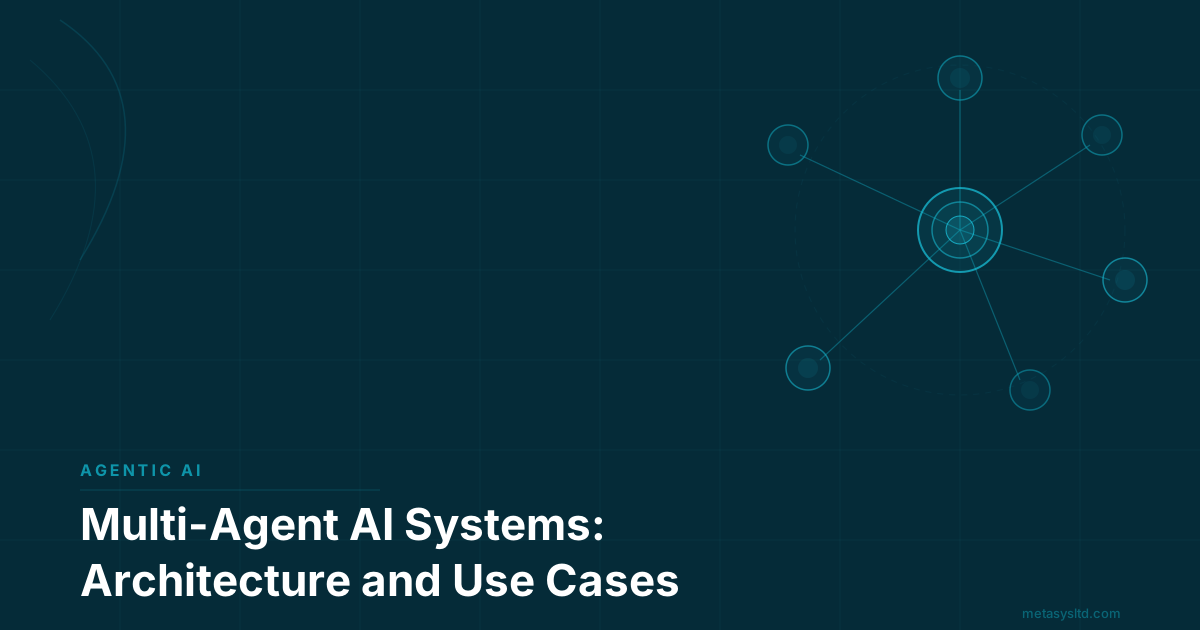
The most common multi-agent architecture uses a coordinator agent (the orchestrator) that receives the top-level goal and breaks it into sub-tasks. The orchestrator routes each sub-task to the appropriate specialized sub-agent, collects results, decides on next steps, and assembles the final output. Sub-agents do not need to know about each other. They know their input format, their tools, and their output format. The orchestrator knows how everything fits together.
This separation of concerns mirrors good software architecture: each component has a defined interface and a single responsibility. It makes the system easier to debug, test, and improve incrementally. When a sub-agent fails or produces low-quality output, you can isolate the problem to that component without tearing apart the rest of the system.
The orchestrator itself can be a relatively lightweight model. Its job is routing and sequencing, not deep reasoning. Many production systems use a faster, cheaper model for orchestration and reserve more capable models for the sub-agents that need complex reasoning. This has meaningful cost implications at scale.
Examples of Specialized Sub-Agents
A research agent specializes in information retrieval and synthesis. It knows how to query web search, internal knowledge bases, vector stores, and databases. It returns structured summaries with source citations. It does not write, validate, or submit anything.
A writing agent specializes in generating prose, structured documents, or formatted outputs from structured inputs. It receives a brief or a set of facts and produces a draft. It does not research or validate. Its quality bar is set by the prompt engineering and any style guidelines baked into its system instructions.
A validation agent checks output against defined criteria. It might verify that a generated document contains all required fields, that numbers add up correctly, that extracted data matches the source document, or that an API response has the expected structure. It returns a pass/fail result with a list of issues found.
A submission agent handles the actual execution of external actions: sending emails, posting to APIs, writing to databases, submitting forms. It does not decide what to submit. It receives the validated payload from upstream agents and executes the action, handling retries, rate limits, and error responses.
Asynchronous vs Synchronous Agent Collaboration
In synchronous multi-agent systems, the orchestrator sends a task to a sub-agent and waits for the result before proceeding. This is simpler to implement and reason about, but it means the total workflow time is the sum of every sub-agent's execution time.
Asynchronous systems allow the orchestrator to dispatch multiple sub-agents in parallel and collect results as they arrive. This is significantly faster for workflows where sub-tasks are independent, but it requires more sophisticated state management. The orchestrator needs to track which sub-tasks are in flight, which have completed, which have failed, and what to do in each case.
The choice between synchronous and asynchronous is a function of your latency requirements and the dependency structure of your workflow. If step B depends on the output of step A, they must run sequentially. If steps B, C, and D all depend on step A's output but not on each other, they can all run in parallel once A completes.
State Management in Multi-Agent Systems
State management is the most underestimated engineering challenge in multi-agent systems. Each agent needs access to the context relevant to its sub-task, but not necessarily all the context the orchestrator has. Giving every agent the full state is wasteful and can cause context window problems. Giving each agent too little context causes errors and requires more back-and-forth with the orchestrator.
Production systems typically use a shared state store, a database or in-memory store, that the orchestrator manages. Sub-agents read only the fields relevant to their task and write only their own outputs. The orchestrator assembles state, updates it after each sub-agent completes, and decides what context to include in each sub-agent call. This pattern avoids state conflicts and makes the system's data flow explicit and traceable.
Error Propagation and Failure Handling
In a single-agent system, an error stops that agent. In a multi-agent system, a sub-agent failure raises harder questions: does the orchestrator retry the sub-agent, skip that step, escalate to a human, or abort the entire workflow? The answer depends on the workflow design, the nature of the failure, and the business rules around partial completion.
Well-designed multi-agent systems classify errors by type and define the handling strategy for each. Transient errors (network timeouts, rate limits) trigger retries with backoff. Validation errors (the sub-agent's output did not meet the required format) trigger a retry with an amended prompt. Logic errors or unexpected states trigger human escalation. Catastrophic errors abort the workflow and log a detailed failure trace.
Real Use Case: Insurance Claims Processing
In fintech and banking, insurance carriers are deploying multi-agent systems for claims processing that would have required four separate teams of specialists. The orchestrator receives a new claim and dispatches four sub-agents in parallel: a document extraction agent that parses the claim form, medical records, and photos; a coverage lookup agent that retrieves the policy terms and verifies applicability; a fraud detection agent that runs the claim against known patterns and third-party databases; and a settlement calculation agent that applies coverage rules to the verified loss amount. The orchestrator assembles all four outputs, routes for human review if any flag is raised, and auto-approves if all checks pass. What took days now takes minutes for clean claims.
Real Use Case: Logistics Dispatch
A multi-agent dispatch system handles the full load assignment workflow. The orchestrator receives a new shipment requirement and dispatches a load search agent (find available capacity on the lane), a rate agent (pull current spot and contracted rates), a carrier communication agent (send tender to selected carrier, receive confirmation), and a compliance agent (verify carrier insurance, authority, and safety scores). The orchestrator sequences these appropriately, since you need the load search before tendering, and runs compliance in parallel with rate lookup. A dispatcher reviews only loads that could not be assigned automatically or where compliance flags were raised.
Real Use Case: Software Engineering Workflows
Engineering teams are deploying multi-agent systems for the repetitive portions of the development workflow. A spec parsing agent extracts requirements from a ticket and produces a structured task description. A code generation agent writes the implementation against that spec. A test generation agent writes unit tests for the implementation. A review agent checks the code against style guidelines and common error patterns. The orchestrator assembles the complete pull request and flags it for human review. Developers spend their time on architecture decisions and complex logic, not on boilerplate.
Agent-to-Agent Protocols
The emerging standard for agent communication is formalized in protocols like MCP (Model Context Protocol) and A2A (Agent-to-Agent). These define how agents expose their capabilities, how other agents discover and call them, and how results are structured for consumption. The significance is that agents built by different teams or vendors can interoperate when they conform to the same protocol. This is the difference between a proprietary multi-agent system that is locked to one vendor and an ecosystem where components can be swapped, upgraded, or sourced from multiple providers.
The enterprise guide to agentic AI covers the broader architecture principles that apply before you get to multi-agent specifics. The short version for multi-agent systems specifically: build observability first, define your agent boundaries before writing code, and start with two agents before you build ten.
What Enterprise Teams Need Before Deploying
Before a multi-agent system goes anywhere near production, three things need to be in place. First, an observability stack: every agent action, tool call, decision, and result needs to be logged with enough context to reconstruct what happened and why. Distributed tracing across agent boundaries is essential. Second, approval gates on high-consequence actions: any agent that can send communications, modify financial records, or take actions in customer-facing systems needs a human checkpoint until it has demonstrated consistent accuracy. Third, rollback mechanisms: define upfront which actions are reversible, how to reverse them, and who has the authority to trigger a rollback.
These are not optional features for version 2. They are the foundation without which multi-agent systems cannot be safely operated, audited, or trusted by the business stakeholders who will ultimately decide whether the system stays in production or gets shut down after the first significant failure.