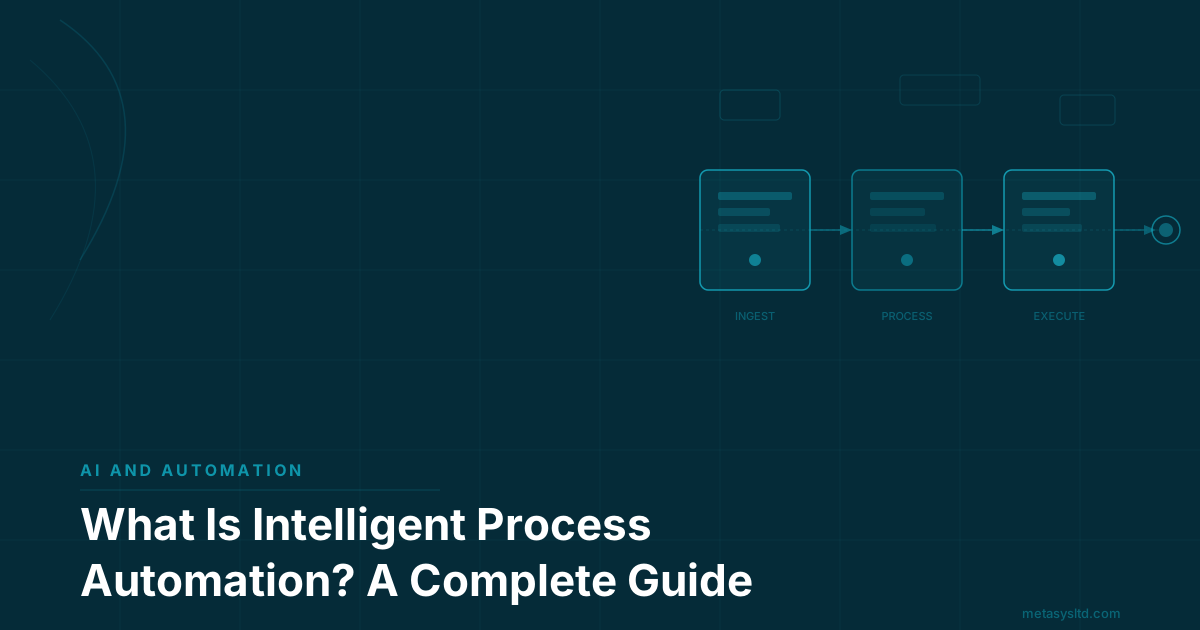
Intelligent Process Automation (IPA) is one of those terms that risks meaning everything and therefore nothing. Vendors apply it to everything from basic chatbots to full agentic systems. For the purposes of practical deployment, IPA has a specific and useful definition: the combination of robotic process automation, artificial intelligence, and machine learning into a single automation layer that handles both structured and unstructured work. That combination is what makes it meaningfully different from either RPA or AI alone.
Organizations that have deployed RPA understand its limits. Organizations that have deployed standalone AI tools understand their limits. IPA is the recognition that the real automation opportunity sits at the intersection: where structured process meets judgment-requiring exceptions, where predictable data flows meet unpredictable inputs, where deterministic rules meet decisions that require context.
The Three Layers of IPA
The first layer is RPA: software that executes deterministic steps in defined systems. It clicks buttons, fills forms, reads from screens, moves data between applications. It works without APIs because it operates at the UI layer. In the IPA stack, RPA handles the structured, repetitive, rules-based execution steps: moving a validated record from system A to system B, logging a completed transaction, triggering a downstream workflow once an upstream step is confirmed.
The second layer is AI for decision-making and exception handling. This is where language models, classification models, and document understanding models do their work. When an invoice arrives as a scanned PDF with no consistent structure, the AI layer extracts the relevant fields. When a customer inquiry comes in as a free-text email, the AI layer classifies the intent and routes it appropriately. When a transaction falls outside the normal pattern, the AI layer flags it for review rather than letting it pass through unchecked.
The third layer is machine learning for continuous improvement. Production automation systems generate enormous amounts of labeled outcome data: this input was classified correctly, this extraction was accurate, this routing decision was right. ML models trained on this data improve over time. An IPA system deployed in year one performs better in year two, not because it was manually updated, but because it learned from its own operational history.
Where Pure RPA Breaks
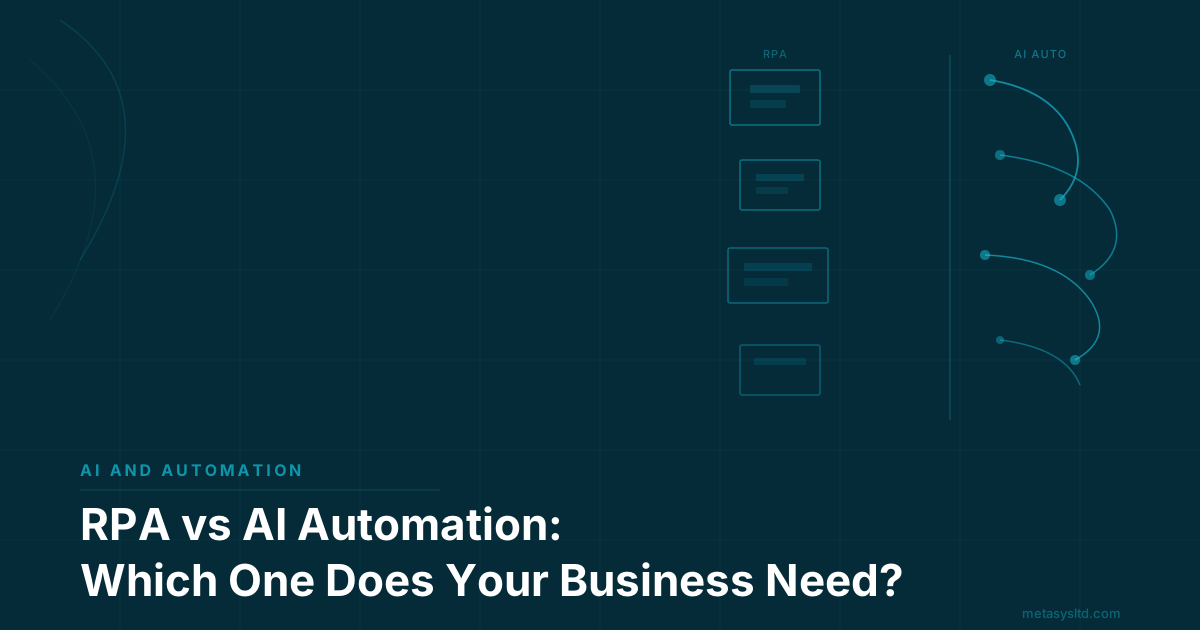
RPA's brittleness is a documented operational reality, not a theoretical concern. The three most common failure modes are UI changes (the vendor updates their portal, the selector breaks, the bot fails silently or noisily), unstructured inputs (a vendor sends a PDF invoice instead of the EDI format the bot was designed for), and exception scenarios not covered by the original script (a field that sometimes appears and sometimes does not, depending on the invoice type).
These failure modes are not edge cases. They are the regular operating conditions of any business that interacts with external parties. Vendors do not coordinate their UI changes with your RPA deployment calendar. Documents arrive in whatever format the sender finds convenient. Real-world business processes have far more exception paths than the happy path that RPA is typically designed around.
The operational cost of maintaining RPA at scale is often significantly higher than the initial build cost. A bot farm of 50 automations in a mid-sized enterprise typically requires a dedicated RPA operations team just to handle breakages, updates, and new exception types. This maintenance burden is what drives organizations toward IPA: the AI layers reduce the brittleness of the overall system by handling variation rather than failing on it.
What AI Adds to Automation
Document understanding is one of the highest-value AI additions to an automation stack. The ability to process a vendor invoice, an employee expense claim, a customer contract, or a regulatory filing regardless of its format removes an entire category of automation blocker. Where RPA required a perfectly structured input, IPA can work with real-world documents.
Natural language inputs extend automation to processes that begin with human communication: emails, chat messages, voice transcripts, form submissions with free-text fields. An AI layer that understands intent, extracts entities (dates, amounts, names, product codes), and structures the input for downstream processing removes the human step that was previously required to translate unstructured requests into structured actions.
Judgment at decision points is perhaps the most significant capability AI adds. Many processes have branch points where a decision is required: approve or reject, escalate or resolve, route to team A or team B. In pure RPA, these branches require explicit rules. In IPA, the AI layer can apply learned judgment to decisions that are too contextual for explicit rules, with human review for low-confidence decisions.
The Automation Maturity Curve
Most organizations sit between manual and partial automation. Full manual means a human does every step. Assisted means AI provides suggestions but humans execute. Partial automation means some steps are automated, humans handle the rest. Full automation means the system handles all standard cases. Autonomous operations means the system handles standard cases and most exceptions, with humans involved only in genuinely novel or high-stakes situations.
The jump from partial to full automation is where IPA makes its biggest impact. Partial automation typically means the structured steps are automated and humans handle exceptions. IPA extends automation to cover most exceptions as well, by giving the system the ability to reason about novel inputs rather than fail on them. Autonomous operations is the state most mature IPA deployments are working toward but few have fully achieved for complex processes.
IPA Use Cases That Produce Real ROI
Invoice processing is the canonical IPA use case because it combines high volume, structured outcomes, and significant input variability. A fully deployed IPA invoice processing system handles receipt (email, portal, EDI), extraction, PO matching, discrepancy flagging, approval routing, and GL posting. Human touchpoints are limited to discrepancies above a tolerance threshold and invoices from new vendors not yet in the system.
Employee onboarding is a process with dozens of sequential steps across multiple systems: account provisioning, equipment ordering, orientation scheduling, policy acknowledgment, payroll setup, benefit enrollment. IPA orchestrates the full sequence, triggers each step based on preceding step completion, follows up on outstanding items, and provides the new hire and HR team with status visibility throughout.
For more on how these principles apply across the automation spectrum, the AI and intelligent automation capability page covers the specific approaches MetaSys uses in production deployments.
How to Choose What to Automate First
The selection criteria for the first IPA target are straightforward. High volume: the automation needs to run frequently enough that the upfront build cost is recovered quickly. Rules-based steps: at least the core happy path should have clear, documentable rules. Clear inputs and outputs: you need to know what information comes in and what structured result should come out. Measurable outcomes: you need to be able to quantify what success looks like before you start building.
A process that meets these four criteria is a good first IPA candidate. A process that fails on all four is a poor candidate regardless of how much the team wants to automate it.
The Business Case: Calculating ROI Before Building
The ROI calculation for IPA has three components. First, labor savings: count the hours currently spent on manual steps in the target process, multiply by the fully loaded hourly cost of the people doing that work, and this gives you the baseline savings potential. Second, error reduction: estimate the current error rate in the process, the cost of each error (rework, customer impact, compliance exposure), and what a 70-90% reduction in errors would be worth annually. Third, headcount avoidance: in growing organizations, the question is not just what you save today but what you avoid hiring as volume scales.
The combination of these three typically produces a payback period of 6-18 months for a well-scoped IPA project. Projects that look at labor savings alone often understate the return because the error reduction and headcount avoidance components are frequently larger than the direct labor savings.
The business modernization service line at MetaSys includes process assessment specifically designed to identify IPA opportunities and build the business case before any engineering work begins.
Common Failure Modes
The most reliable way to fail at IPA is to automate a broken process. If the manual process is poorly defined, has inconsistent outcomes, or requires tribal knowledge to execute correctly, automating it reproduces those problems at machine speed. Process documentation and standardization come before automation, not after.
Skipping change management is the second most common failure mode. IPA changes how people work. The team members whose workflows are being automated need to understand why it is happening, what their role becomes after automation, and how they benefit. IPA projects that land without stakeholder engagement encounter resistance that manifests as adoption problems, workarounds, and ultimately low utilization of the automation.
No monitoring layer means you do not know when the automation is failing, degrading, or producing incorrect outputs. Production IPA systems require active monitoring: alert on exception rates above baseline, flag when extraction confidence drops below threshold, track end-to-end processing time for signs of degradation. Automation without monitoring is a process you have agreed to operate without visibility into how it is performing. That is a worse position than the manual process it replaced, which at least had humans who would notice when things went wrong. Refer to the companion post on AI automation vs traditional automation for a deeper comparison of these monitoring and governance requirements.