Research on enterprise software projects consistently shows that the majority fail to deliver their intended value. AI initiatives have a worse track record. Industry estimates put the proportion of AI projects that never reach production somewhere between 70 and 85 percent. The technology is not the primary reason. Most AI failures are management failures, process failures, and organizational failures that happen to involve technology.
This is not a comfortable thing to say if you are selling AI projects, but it is the most useful thing to understand if you are running one. The framework described here is built on the failure modes we have observed repeatedly, and the disciplines that prevent them.
The Five Failure Modes
Before describing what to do, it is worth being specific about what goes wrong.
- Wrong use case selection. The team picks an AI use case because it is technically interesting or because a vendor demonstrated it, not because it solves a real business problem with measurable impact. The project completes, nobody uses it, and it is quietly decommissioned.
- Data that is not ready. The assumption is made that data exists and is usable. In practice, the data is in seven different systems, inconsistently formatted, missing key fields, and has no documented lineage. Six months of the project timeline goes to data archaeology.
- No clear owner. AI projects that are owned by IT are treated as IT projects. AI projects that are owned by a business unit without IT involvement cannot get to production. Without a single accountable owner who spans both domains, projects stall in the space between them.
- No change management. The technical system works. The people who were supposed to use it do not change their behavior. The model makes recommendations that nobody acts on. The automation runs but humans duplicate its work manually because they do not trust it.
- Measuring the wrong things. The team tracks model accuracy metrics. The business cares about processing time, error rate, or cost per transaction. When the connection between model performance and business outcomes is not explicit, the project cannot demonstrate its own value.
The Framework: Diagnose, Architect, Automate, Scale, Govern
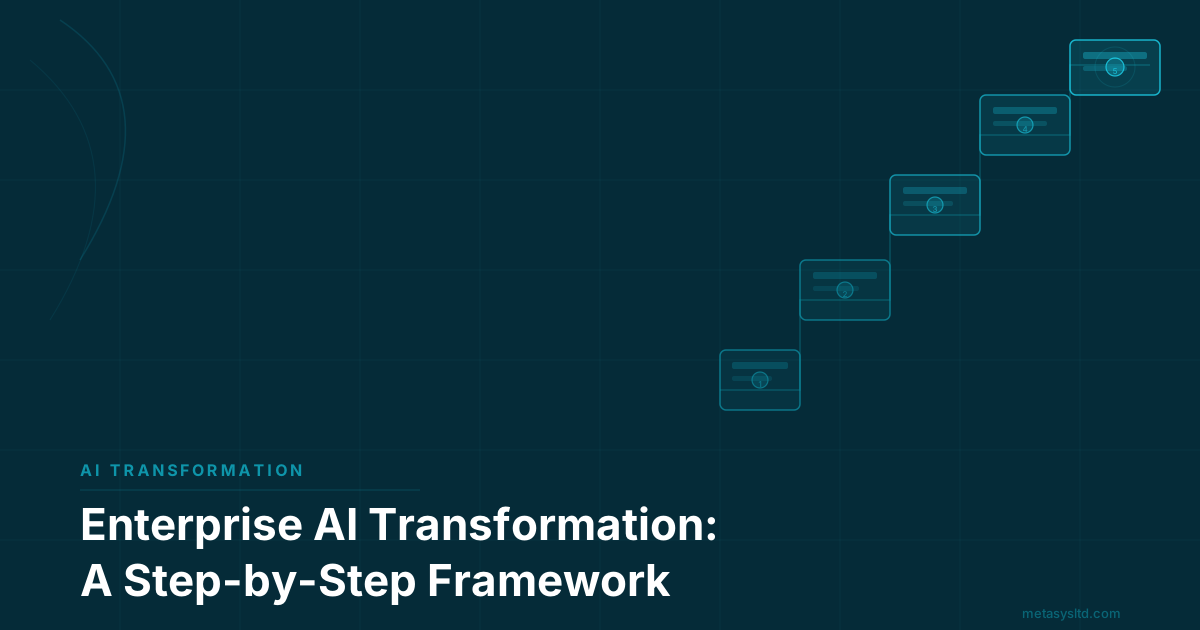
The five-phase framework we apply to every agentic AI systems engagement is structured specifically to prevent these failures. Each phase produces artifacts that inform the next. Skipping phases is possible but creates technical debt that compounds.
Phase 1: Diagnose
The Diagnose phase identifies the right use cases before any technology decisions are made. The criteria for a good AI use case are specific: high volume (the process happens frequently enough that automation produces meaningful scale), clear outcome (you can define what success looks like in measurable terms), and data exists (there is sufficient historical data, or a clear path to collecting it).
The use case scoring matrix evaluates candidates across these dimensions plus business impact and implementation complexity. The output is a ranked list of use cases with a clear recommendation for where to start. The use case at the top of the list is rarely the most exciting one. It is the one most likely to succeed in a reasonable timeframe.
Diagnose also includes a data readiness assessment: what data exists, where it lives, what its quality is, and what would need to happen to make it usable. This assessment frequently changes the use case ranking. A technically interesting use case with poor data availability gets deprioritized in favor of a less exciting use case with clean, accessible data.
Phase 2: Architect
Architecture happens before code. The Architect phase produces a system design that covers: what AI components are required, what integration points exist with existing systems, what data flows where, what humans remain in the loop and where, and what the monitoring and governance requirements are.
The human-in-the-loop question deserves specific attention. For most enterprise AI systems, the right design is not full automation but assisted automation: AI handles the high-volume routine cases, humans handle exceptions and edge cases, and the system is designed to escalate gracefully. Designing this escalation path upfront prevents brittle systems that fail silently when they encounter inputs outside their training distribution.
Architecture also determines build vs buy decisions. For commodity capabilities (document extraction, sentiment analysis, standard classification tasks), vendor APIs are usually the right answer. For differentiated capabilities that represent competitive advantage, building proprietary systems is worth the investment. Mixing both is normal.
Phase 3: Automate
The Automate phase builds the first production system. The key discipline here is to start narrow. A workflow automation that handles one specific process end-to-end is infinitely more valuable than a broad system that partially handles ten processes. Narrow scope means faster delivery, clearer measurement, and the ability to learn before expanding.
The distinction between a pilot and a production system is critical. A pilot demonstrates that a technology works. A production system handles real volume, integrates with real systems, has monitoring, has rollback capability, and has a support model. Many AI initiatives deliver pilots and call them production systems, then wonder why adoption stalls.
On our AI and intelligent automation engagements, the definition of done for Phase 3 includes: the system is running in production with real data, error rates are below defined thresholds, monitoring is live, and there is documented runbook for operations.
Phase 4: Scale
Moving from one automated workflow to ten is not a multiplication exercise. Scale introduces new requirements across every dimension.
Governance complexity increases because you now have multiple models in production, each with different training data, different performance characteristics, and different failure modes. A governance function that was manageable for one system becomes unmanageable for ten without explicit investment in tooling and process.
Data infrastructure requirements change. A single model might work fine pulling data from a replicated database. Ten models with different data dependencies require a more systematic approach to data pipelines, feature management, and data quality monitoring.
Team structure also changes. The small cross-functional team that built the first system cannot maintain ten systems and build the eleventh simultaneously. Scale requires explicit decisions about platform capabilities, team responsibilities, and ownership models.
Phase 5: Govern
Governance is not a post-deployment concern. It needs to be designed in from the start, but it becomes most visible at scale. The Govern phase covers: audit trails (every AI decision logged with inputs and outputs), access controls (who can modify models, who can see model outputs), bias monitoring (systematic checks for demographic or categorical disparities in model outputs), model drift detection (alerts when model performance degrades from baseline), and incident response (what happens when the AI system makes a consequential error).
Incident response for AI systems is different from incident response for software bugs. An AI model that starts making systematically wrong recommendations may not produce visible errors. The failure mode is silent and gradual. Monitoring must be designed to catch drift before it becomes a business problem.
Organizational Change: The Part That Is Not Technical
The AI champion model is the most reliable organizational mechanism for successful transformation. An AI champion is a senior business leader who owns the transformation outcomes, has authority to make process changes, and can bring their team along. Champions are not IT sponsors. They are accountable business leaders who understand enough about AI to ask good questions and have enough organizational credibility to drive adoption.
Without a champion, AI initiatives tend to be adopted enthusiastically by the technically curious and ignored by the people who do the actual work. The champion's job is to make AI adoption a professional expectation rather than an optional experiment.
What 12 Months Looks Like for a 500-Person Company
A realistic 12-month enterprise AI transformation timeline for a mid-size company looks like this: months one and two on Diagnose, producing a prioritized use case list and data readiness assessment. Months three and four on Architect, producing system designs and integration specs for the top two use cases. Months five through eight on Automate, delivering the first production system. Months nine and ten on measurement, refinement, and preparing to scale. Months eleven and twelve beginning Scale, expanding to two or three additional workflows.
At month twelve, a well-run transformation has one proven production system, two or three systems in active development, a governance function in place, a team with hands-on production experience, and a data infrastructure foundation that can support continued expansion. That is a durable platform for the next three years, not a project that ends.
For companies ready to begin this work, the starting point is a structured discovery engagement. Our business modernization service is designed for exactly this starting point: organizations that know they need to change and need help figuring out where and how to start.