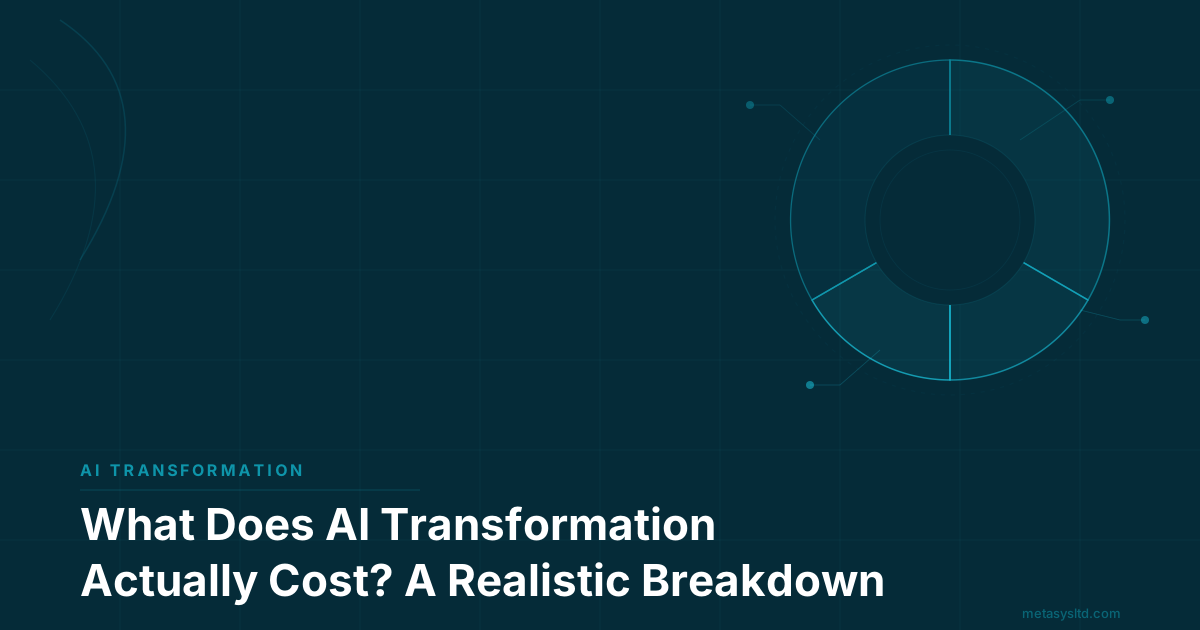
When someone asks how much an AI transformation costs, the honest answer is somewhere between $50,000 and $5,000,000 depending on scope, complexity, and approach. That range is technically accurate and completely useless for planning purposes. This post breaks down the five cost categories, explains what drives costs in each, and gives you the tools to build a realistic budget for your own context.
Why the Range Is So Wide
A $50,000 AI project might be a well-scoped workflow automation that automates a single high-volume manual process using existing APIs and clean data. A $5,000,000 AI transformation might involve building proprietary models on messy enterprise data, integrating with twelve legacy systems, and rolling out to 2,000 users across multiple countries.
The variables that drive cost are: how complex the AI problem is (off-the-shelf model vs custom training), how bad the data situation is (clean warehouse vs scattered legacy systems), how many integration points exist, what the deployment environment looks like (greenfield cloud vs on-premises enterprise), and who does the work (offshore junior team vs senior specialists). Each of these variables can move total cost by 2 to 5 times.
Cost Category 1: Infrastructure
Infrastructure costs cover cloud compute, storage, model APIs, and monitoring tools. For most production AI systems, these break down into three buckets.
Cloud compute for AI inference varies dramatically based on whether you are calling external model APIs or running your own models. If you are using OpenAI, Anthropic, or Google APIs, costs are per-token: typically $1 to $15 per million input tokens depending on the model, and $3 to $60 per million output tokens. A production system processing 100,000 document pages per month at 1,000 tokens per page is processing 100 million tokens monthly. At $3 per million input tokens, that is $300 per month in model API costs alone, before processing overhead.
If you are running your own models (fine-tuned or open-source), you pay for GPU compute. A single A100 GPU instance on AWS costs roughly $3 to $4 per hour. A production system with modest traffic might need two to four instances for redundancy and throughput, adding $5,000 to $12,000 per month.
Storage for AI systems includes vector databases (for retrieval-augmented generation), training data storage, and model artifact storage. A well-configured mid-scale system typically runs $500 to $2,000 per month in storage costs. Monitoring tools (Datadog, Grafana, specialized ML monitoring like Arize or Fiddler) add another $500 to $3,000 per month depending on the level of observability you need.
Total infrastructure for a mid-scale production AI system: $3,000 to $20,000 per month, with wide variance based on the factors above.
Cost Category 2: Development
Development is the largest cost variable and the one most influenced by team composition. For our business modernization engagements, a workflow automation project for a well-defined scope typically ranges from $50,000 to $200,000 for initial development.
What puts a project toward the lower end: the use case is well-defined, the data is accessible and reasonably clean, the integration surface is limited (one or two systems), and you are using platform-based tooling rather than building from scratch. What pushes toward the upper end: the use case requires custom model development, the data needs significant preparation, the integration surface is complex, or the deployment environment has unusual constraints.
Team composition has an enormous effect on cost. A senior offshore specialist team is typically 40 to 60 percent less expensive than an equivalent onshore team, but requires more active oversight to maintain quality. A junior offshore team is the cheapest input and frequently the most expensive output: low-quality code creates technical debt that costs multiples to unwind.
Cost Category 3: Data Preparation
Data preparation is consistently the most underestimated cost in AI projects. It is common for data work to consume 30 to 40 percent of total project budget. For projects where the data situation is particularly bad, that number can be higher.
Data preparation work includes: identifying and accessing data sources, cleaning and standardizing formats, handling missing values, removing duplicates, resolving entity references across systems, creating labels for supervised learning tasks, building data pipelines to keep training data current, and documenting lineage. None of this is glamorous, and all of it is necessary.
For projects that require labeled training data, labeling is a significant line item. Professional annotation services charge $0.05 to $2.00 per label depending on complexity. A document classification model that needs 10,000 labeled examples at $0.50 per label is $5,000 in annotation costs before any development begins. Medical or legal labeling requiring domain expert annotators can be 10 times that rate.
Cost Category 4: Integration
Integrating AI into existing enterprise systems is where many projects discover the "enterprise integration tax." The last 20 percent of an integration frequently takes 80 percent of the time. This happens because enterprise systems have inconsistent APIs, undocumented edge cases, data format variations that only appear with production data volumes, authentication schemes that require special handling, and rate limits that were not documented anywhere.
Budget integration work at roughly $15,000 to $30,000 per major system integration point for a reasonably complex enterprise environment. If you have four systems to integrate, budget $60,000 to $120,000 for integration work, and expect it to take longer than planned.
Cost Category 5: Ongoing Operations
The initial build is not the end of costs. AI systems require ongoing maintenance that most initial budgets underestimate. Budget 15 to 25 percent of the initial build cost per year for operations.
Ongoing operational costs include: model monitoring and retraining when drift is detected, prompt engineering updates as underlying models are updated by providers, infrastructure scaling as usage grows, security patches and dependency updates, and user support. For agentic AI systems specifically, the operational surface is larger because agent behavior can change subtly with model updates, requiring ongoing evaluation and adjustment.
The Phased Approach: Why It Saves Money
The highest-risk AI investment is a large upfront commitment before proving value. A $500,000 full deployment that fails to deliver ROI is a much worse outcome than a $100,000 pilot that fails and teaches you what would actually work.
A well-structured phased approach looks like this: a $75,000 to $125,000 discovery and pilot phase that proves the use case with real data in a limited production environment. If the pilot meets defined success criteria, a $300,000 to $600,000 full deployment phase follows. If the pilot does not meet criteria, you have spent $100,000 to learn something valuable rather than $600,000 to learn the same thing.
Red Flags in an AI Vendor Proposal
A proposal with no architecture detail should be questioned. You should be able to understand what systems will be built, what technologies will be used, and how the AI component integrates with your existing environment. A proposal that is vague on these points often reflects a team that has not thought through the technical approach.
Pricing that seems too low (below $50,000 for anything genuinely complex) usually means a junior team, offshore work without senior oversight, or a platform-based approach that will not meet your specific requirements. None of these are inherently wrong, but they should be understood upfront rather than discovered mid-project.
Guarantees of specific model accuracy metrics before seeing your data are a red flag. No honest practitioner can tell you a model will achieve 95 percent accuracy before understanding your data distribution, label quality, and edge cases.
Building the ROI Case for Your CFO
The ROI calculation for AI projects has three components: cost reduction (labor hours saved multiplied by hourly cost), revenue impact (if the AI system enables faster processing, better decisions, or new capabilities that generate revenue), and risk reduction (value of errors avoided, compliance issues prevented, or fraud caught).
Be conservative on revenue impact because it is the hardest to prove. Be specific on cost reduction because it is the most defensible. A system that automates 80 percent of a process that currently requires 5 FTEs at $60,000 per year each generates $240,000 in annual labor cost reduction (assuming the 20 percent requiring human handling requires proportionally less FTE capacity). Against a $200,000 implementation cost, that is a payback period of under 12 months.
To discuss what realistic costs look like for your specific context, the best starting point is a structured conversation: book a consultation and come prepared with a specific use case and some information about your data environment. Vague conversations produce vague estimates.