A Global Capability Center (GCC) is not outsourcing. The distinction matters, both operationally and strategically.
Outsourcing means you pay a vendor to deliver outcomes. You define what you need, the vendor defines how to deliver it, and quality depends on the contract, the vendor's internal incentives, and your ability to manage a third party at arm's length.
A GCC means you build and operate your own engineering team in a specific geography, using the talent density and cost structure of that location while retaining direct management, culture, and intellectual property within your organization. The team uses your tools, follows your processes, reports to your leadership, and builds institutional knowledge that stays with you.
The Pakistan talent market
Pakistan produces over 30,000 engineering graduates annually, with a growing concentration in software engineering, data science, and AI. English is the primary language of higher education and professional settings, which significantly reduces the communication friction common in offshore teams where technical staff operate in their second or third language for written and verbal collaboration.
Time zone alignment is a structural advantage that is often underestimated. Pakistan Standard Time (UTC+5) gives a five-hour overlap window with Central European Time and a four to five hour window with Gulf Standard Time. For US teams in Eastern and Central time zones, a Pakistan-based team operating from 9am to 6pm PKT provides two to four hours of same-day overlap. That is enough for daily standups, code reviews, and escalation resolution without requiring either side to work unusual hours.
Cost comparison
Engineering talent costs in Pakistan run roughly sixty to seventy percent lower than equivalent roles in the US market, and twenty to thirty-five percent lower than India depending on the specific skill and seniority level. This is not a commodity cost argument. The relevant comparison is whether a senior engineer in Lahore, working full-time under your management, produces comparable output to a senior engineer in Boston or Berlin. For most software engineering and AI work, the answer is yes, with appropriate hiring standards and management.
Eastern Europe has been a common alternative, but significant supply constraints, currency fluctuations since 2022, and increasing competition from US tech company hiring in those markets have pushed costs higher. Pakistan's talent pipeline remains less competitive and more abundant for the seniority levels most GCCs need.
How MetaSys structures GCC pods
A pod at MetaSys is a cross-functional team of five to ten people with defined ownership of a product area, service domain, or technical function. Each pod includes engineering, QA, and technical leadership. We handle recruitment, onboarding, tooling setup, office infrastructure, and HR compliance. You maintain direct management authority. Pod leads report to your engineering leadership through whatever structure you define.
This is not a staffing arrangement where we provide headcount on request. It is a team delivery model where MetaSys manages the operational layer while you own the work, the roadmap, and the outcomes. More detail on the specific model is on our Global Capability Centers capability page. For companies that also need ongoing AI operations management alongside the engineering pod, our Managed AI Operations service provides continuity across model monitoring, retraining, and production support.
Governance model
The governance question, how do you ensure quality and delivery when your team is thousands of miles away, is what most companies get wrong when they start an offshore program.
The answer is not heavy reporting overhead. It is alignment on ways of working: sprint cadence, definition of done, code review standards, on-call expectations, and deployment process. When these are explicit and consistently applied, distance stops being a quality risk.
The things that make a GCC fail are the same things that make any distributed team fail: unclear ownership, slow decision cycles, and treating the remote team as an extension of the org chart rather than a full team with autonomy in their domain. Geography is a factor, but it is rarely the primary one.
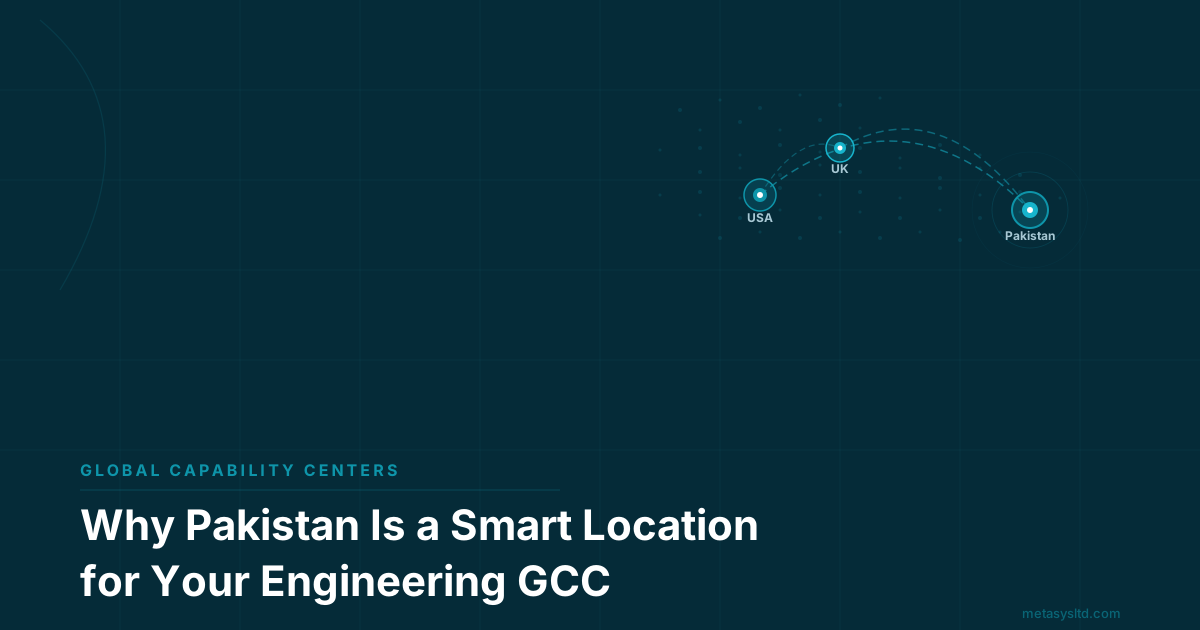
For companies exploring whether a GCC is the right model, the About MetaSys page covers our founding context and approach in detail, including how we operate across our own three-geography delivery model in Missouri, Manchester, and Lahore.
Where to start
The practical starting point is narrow: one pod, one clear scope, one engineering leader on both sides who understands the model. Get that working, then expand. We have not seen a GCC program succeed that tried to launch at full scale before the operating model was validated.