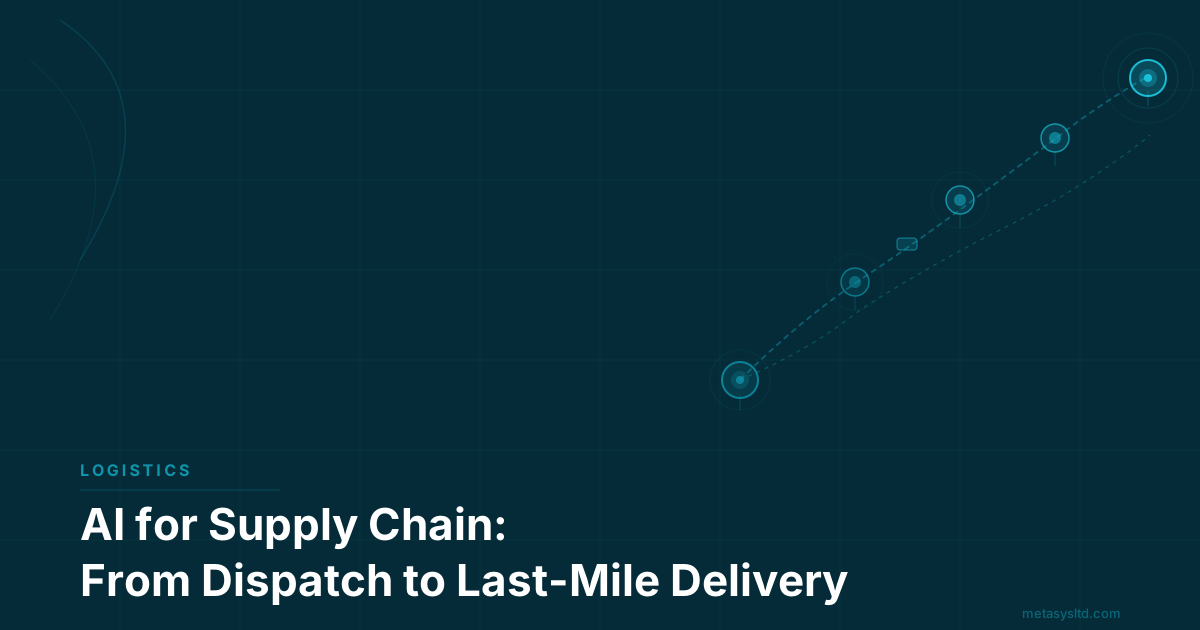
Supply chain operations run on decisions: which supplier to use, how much inventory to hold, which route to take, which carrier to select, how to respond when something goes wrong. Most of these decisions are made repeatedly, at scale, with imperfect information. That profile is exactly where AI creates the most value. The gap between what well-implemented supply chain AI can achieve and what most logistics operations actually do is significant and narrowing as implementation costs decrease.
Where the Biggest Inefficiencies Are
The highest-value inefficiency in most supply chains is forecast error and the inventory cost it generates. Excess inventory ties up working capital and creates markdown risk. Insufficient inventory creates stockouts and lost sales or delayed fulfillment. The combined cost of these two error modes typically represents three to five percent of revenue for mid-size logistics and retail operations, which is larger than their net margin.
The second major inefficiency is unplanned carrier capacity and routing decisions made under time pressure. When a driver does not show up, when a load needs to be placed at the last minute, when a route needs to change due to traffic or weather, decisions made reactively are worse and more expensive than decisions made proactively with AI assistance.
Visibility gaps create a third category of inefficiency. Shipments that go silent until they arrive (or do not arrive) create customer service costs, expediting costs, and relationship damage. The information to predict delays often exists in carrier systems before the delay becomes visible to the shipper.
Demand Forecasting: Highest ROI in Supply Chain
For logistics and transportation operators, demand forecasting means predicting the volume of freight by lane, mode, and time period. For shippers, it means predicting the volume and mix of products that need to be moved. In both cases, ML-based forecasting consistently outperforms traditional time-series methods by 15 to 30 percent on standard accuracy metrics.
The data requirements for supply chain demand forecasting include: historical volume by relevant dimensions (lane, product category, origin-destination pair), calendar features (day of week, holidays, seasonality), external signals where available (economic indicators, weather forecasts for weather-sensitive freight, promotional calendars from customers), and supply-side constraints (carrier capacity, driver availability, infrastructure limitations).
Gradient boosting models (LightGBM, XGBoost) perform well for structured tabular data in supply chain contexts and are interpretable enough to build trust with operations managers who need to understand why the model is forecasting what it is forecasting. Neural approaches (temporal fusion transformers, N-BEATS) can provide additional accuracy for complex seasonality patterns at the cost of interpretability.
Inventory Optimization
A demand forecast is only the input to inventory optimization. The output is a procurement and positioning decision: how much to order, when to order it, and where to hold it. Connecting forecast to action requires modeling supplier lead times (including their variability, not just their average), warehouse capacity constraints, transportation costs between network nodes, and service level requirements for each product or lane.
Dynamic safety stock, adjusted based on current demand variability rather than historical averages, reduces both excess inventory and stockouts compared to static safety stock rules. The calculation is straightforward: safety stock is a function of demand variability, lead time variability, and the desired service level. Updating these inputs continuously rather than annually captures changes in supply chain conditions as they happen.
Supplier communication automation triggered by the replenishment system reduces the manual work of purchase order management. When inventory falls below reorder points or forecasts change significantly, automated notifications to suppliers and internal buyers ensure timely action without requiring manual monitoring.
Route Optimization: The Traveling Salesman Problem at Scale
Route optimization is one of the oldest problems in operations research. Classical approaches use exact algorithms (which are computationally intractable for large problem sizes) or heuristics (which find good but not necessarily optimal solutions quickly). Modern ML approaches combine learned heuristics (trained on historical routing decisions) with classical OR methods (applied at smaller sub-problem scales) to achieve near-optimal routing at practical computational speeds.
The distinction between pre-planned routes and real-time dynamic routing is operationally important. Pre-planned routes optimize across a full day's delivery schedule before the day begins. Real-time dynamic routing adjusts routes continuously as conditions change: traffic, failed deliveries, last-minute additions. Dynamic routing requires lower-latency computation and a tighter integration with driver communication systems.
For last-mile delivery networks, route optimization accounts for time windows (customers available during specific hours), vehicle capacity, driver shift constraints, and regulatory requirements (HOS rules for commercial vehicles). The value of optimization compounds at scale: a two-percent reduction in total distance driven across a fleet of 1,000 trucks generates significant annual fuel savings.
Dispatch Automation
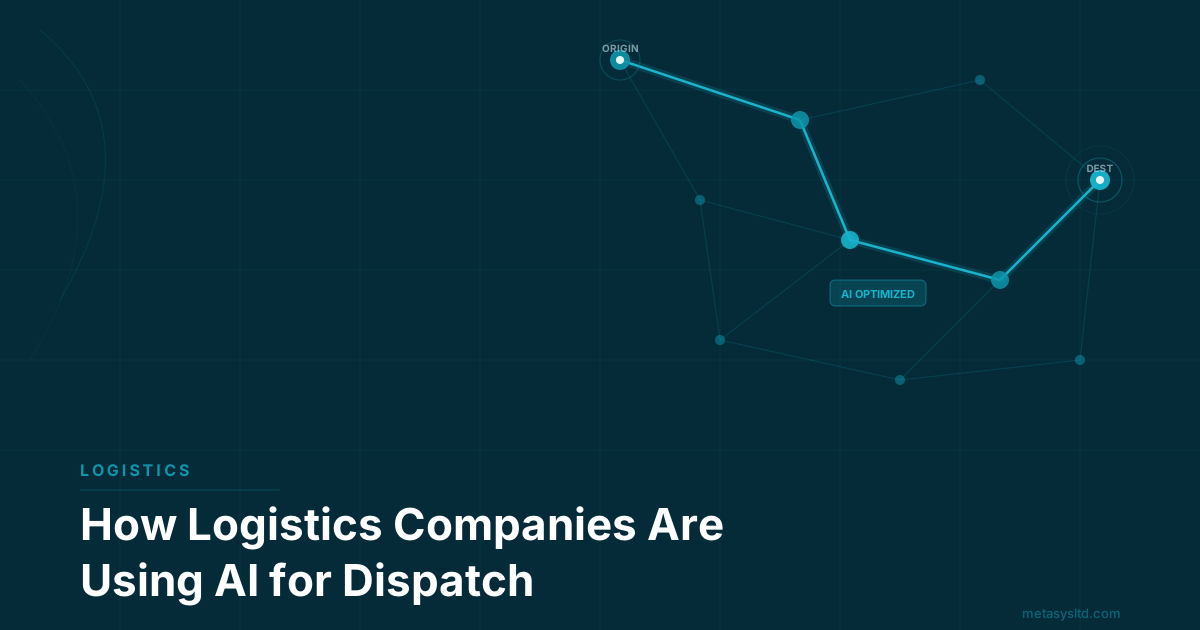
Automated dispatch handles load matching, carrier selection, and rate negotiation without manual intervention for routine transactions. Our logistics operations work implements dispatch agents that operate as follows: when a load is available, the agent retrieves relevant criteria (origin, destination, commodity, timing, equipment requirements), queries available carrier capacity across integrated APIs, ranks candidates by a scoring function that incorporates price, carrier performance history, transit time, and current lane volume, and initiates booking with the top-ranked carrier automatically or presents a ranked list for human confirmation on high-value loads.
The automation rate for dispatch varies by load type. Routine LTL and FTL loads on established lanes with integrated carriers can be automated at 70 to 85 percent. Specialized freight, oversized loads, and loads requiring unusual equipment require human judgment more frequently.
Freight Rate Prediction
Spot market freight rates fluctuate significantly with supply and demand dynamics. ML models trained on historical rate data, capacity utilization signals, macro-economic indicators, and seasonal patterns can predict near-term rate movements with meaningful accuracy. Brokers use these models to time purchases. Carriers use them to price dynamic capacity. Shippers use them to decide whether to contract now or wait for spot capacity.
Rate prediction models perform best for lanes with high transaction volume and stable infrastructure. They perform worse for niche lanes, unusual commodity types, or periods following major market disruptions (which are, by definition, out-of-distribution events).
Visibility and Exception Management
AI-powered visibility platforms aggregate tracking data from carrier APIs, EDI feeds, and telematics systems to provide a unified view of in-transit shipments. The AI layer adds predictive capability: given current location, carrier performance history, weather conditions, and lane congestion patterns, what is the predicted delivery time and what is the probability of an on-time arrival?
Proactive exception management triggers alerts and actions when delay probability exceeds thresholds: notifying customers before they call, initiating contingency planning before a delay becomes a missed appointment, and creating a paper trail for carrier performance management. The value is measurable in customer satisfaction scores and exception handling labor costs.
For a practical view of how AI is applied to dispatch specifically, see our guide on how logistics companies use AI for dispatch.
Warehouse Operations: What Is Mature vs Experimental
Pick path optimization for warehouse order fulfillment is mature technology. Systems that sequence pick tasks to minimize travel distance are in production at thousands of warehouses and deliver measurable productivity improvements. Inbound and outbound dock scheduling using appointment optimization is similarly mature.
Autonomous mobile robots for warehouse material transport are mature for structured environments with high-volume, repetitive tasks. The ROI depends heavily on labor costs, throughput requirements, and facility layout. The economics are favorable in regions with high labor costs and high fulfillment volume; less favorable for low-volume, high-mix operations.
Fully autonomous picking robots (that pick arbitrary SKUs from unstructured bins) are still in early commercial deployment. The accuracy and speed required for cost-effective operation are achievable in controlled conditions but not yet reliable across the full range of product types in a typical warehouse.
Implementation Starting Points
For a mid-size logistics operator with limited data infrastructure, the recommended starting point is demand forecasting for your highest-volume lanes combined with a basic data warehouse that integrates TMS, WMS, and carrier data. This combination produces immediate value from the forecasting application while building the data foundation required for every subsequent AI application. Starting with a harder problem (autonomous dispatch, real-time route optimization) before this foundation is in place typically produces disappointing results because the data quality is insufficient to support reliable models.